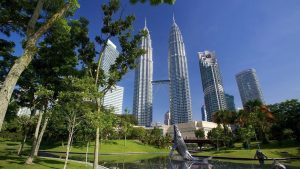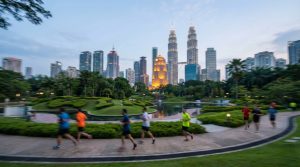

If your running life has been shaped by crisp London mornings, the North Sea breeze in Amsterdam, or even a warm Sydney summer that still cools down overnight, Malaysia can feel like a different sport. Warm season in London lives mostly in the teens to low-20s °C. Amsterdam summer highs hover around ~20–22°C.
Kuala Lumpur, by contrast, sits in a narrow band of heat year-round—roughly 23–33°C—and it’s the humidity that makes it bite.
The key difference isn’t just temperature. It’s that Malaysia regularly gives you high humidity at the exact times you want to run. MetMalaysia notes maximum daily average relative humidity is typically over 94% and can reach 100%.
So even when the sun isn’t up yet, the air can still feel thick—because dew point changes slowly, meaning a muggy day is often followed by a muggy night.
This is the practical guide I wish every visiting runner had before toeing a Malaysian start line.
Summary of Temperature and Humidity Based on Top Running Locations in Malaysia
| # | Trail running location (Malaysia) | Example trails | Typical daytime temp (°C) | Typical night / early-AM temp (°C) | Quick note |
| 1 | Klang Valley (Petaling Jaya/KL) | Bukit Kiara, Gasing Hill, FRIM (Kepong) | ~32 | ~23–24 | Hot + humid year-round; shade helps but humidity stays high. |
| 2 | Penang Hill (Bukit Bendera) | Penang Hill climb routes, heritage stair/road climbs | ~20–27 | ~18–21 | Cooler than Georgetown; still humid, but far more runnable mid-day than lowlands. |
| 3 | Langkawi (Gunung Raya area) | Gunung Raya forest roads/trails | ~32 | ~25 | Island heat: warm nights; plan early starts. |
| 4 | Gunung Ledang area (Tangkak, Johor) | Ledang summit routes | ~31–32 | ~23–24 | Lowland base is hot; summit sections can be cooler/windier. |
| 5 | Cameron Highlands (Tanah Rata) | Mossy/tea-estate trails, ridge runs | ~24 | ~15 | One of the best “escape the heat” training bases. |
| 6 | Fraser’s Hill (Pahang) | Forest loops, rolling highland trails | ~22–23 | ~16–17 | “Goldilocks” running weather by Malaysia standards. |
| 7 | Genting Highlands (Pahang/Selangor border) | Hill station climbs, cool foggy runs | ~22 | ~12 | Big drop at night; can feel surprisingly chilly when wet/windy. |
| 8 | Bukit Larut / Maxwell Hill (Taiping, Perak) | Steep access road + jungle trails | ~15–25 | ~10 | Among the coolest (and wettest) places—pack a light layer |
| 9 | Kinabalu area base (Kundasang, Sabah) | Kinabalu foothills, acclimatisation hikes/runs | ~23–25 | ~16–17 | Cool mountain air; mornings can feel crisp. |
| 10 | Kota Kinabalu region (Sabah) | Kokol Hill / coastal-hill routes | ~32 | ~24 | Coastal Borneo heat—similar to KL, but breezes vary by route. |
Why Malaysia feels harder than London/Sydney/Amsterdam
In dry or temperate air, sweat evaporates easily and cools you. In humid air, evaporation slows—so your “cooling system” becomes less effective even if you’re sweating buckets.
The body responds by pushing more blood toward the skin to dump heat, which creates a cardiovascular squeeze: you’re trying to supply working muscles and cool the engine at the same time according to a study published by Journal of Phyisiology.
That’s when you notice the classic Malaysia combo:
- Higher heart rate for the same pace
- A feeling of “overheating” earlier than expected
- A pace that collapses late if you insist on racing your temperate-climate numbers
According to a study published by Ely et. Al, this is evident in the racing data: marathon performance slows progressively as WBGT (Wet Bulb Globe Temperature) rises.
And the “fast marathon” sweet spot is typically around ~10–12°C, far cooler than what lowland Malaysia usually offers, as cited in Frontiers of Physiology.
Start times are not a vibe—they’re a survival strategy
Race organizers in Malaysia schedule like people who’ve learned the hard way.
- Penang Bridge International Marathon flags off the full marathon at 1:30am and the half at 3:00am.
- Borneo International Marathon (Kota Kinabalu) lists a full marathon start time of 2:00am (2026 terms).
- Kuala Lumpur’s big weekend road events often push running early too (e.g., 10K listed at 6:00am on the official schedule page).
If you’re coming from places where a 9am long run is normal, Malaysia teaches you a new rule: you don’t “beat the heat” here—you simply run before the day fully arrives.
Practical timing tips:
- Road running: aim for pre-sunrise to early sunrise whenever possible.
- Trail running: start early and plan for slower descents if humidity + rain makes roots and rocks slick.
Pacing adjustments: run the effort, not your watch
The biggest mistake visiting runners make is trying to “hold” their London/Amsterdam pace because the distance looks familiar. In tropical Malaysia, your pacing plan should be built around effort caps, not target splits.
A useful mindset: pace is a output; heat/humidity are a tax on that output. Race data shows performance penalties climb as WBGT rises—and slower runners tend to be hit harder than elites.
How to adjust, practically:
- Start 15–30 seconds/km easier than you think for the first 20–30 minutes (yes, even in a race). Let your breathing settle.
- Use HR or RPE caps (more on HR drift below). In tropical conditions, a “steady” run can feel like threshold if you chase pace.
- Respect the second half. The humidity doesn’t “let up” when you get tired.
And don’t assume Malaysia is always lowland furnace. One fun twist: Cameron Highlands trail races (often referred to as CULTRA / Cameron Ultra) can be dramatically cooler—Bernama described a running climate around ~18°C in that region.
Cooler doesn’t mean easy (the climbing and technical trails can be brutal), but it changes the heat equation.
Heart-rate drift: why your HR climbs even when pace doesn’t
In the tropics, your heart rate often rises over time during a steady effort—this is cardiovascular drift. It’s typically characterised by a progressive HR increase and reductions in stroke volume during prolonged exercise, and it’s exacerbated by heat stress, according to a study published in the Life Sciences journal.
What’s driving it?
- More blood diverted to the skin for cooling
- Gradual dehydration reducing plasma volume
- Rising core temperature increasing cardiovascular strain (Gonzalez-Alonso et.al, Journal of Physiology)
How to use this in Malaysia:
- Treat your HR like a “heat meter.” If HR climbs 8–15 bpm at the same pace, it’s not weakness—it’s physiology.
- In long runs, consider a negative split by effort, not by pace: keep HR steady and allow pace to drift slightly slower early, then hold form late.
Hydration in Malaysia: the science, the numbers, and the reality
1) How much do you actually lose?
MDPI found that typical sweat rates during activity are often ~0.5–2.0 L/hour, with big individual variation. In hotter conditions, sweat loss can be even higher—classic physiology texts note sweat rates can reach 3–4 L/hour in extreme cases, as found by NCBI.
2) How much should you drink?
The 2007 ACSM guidance as published in the SEMS-Journal, commonly frames endurance drinking around ~0.4–0.8 L/hour as an ad-libitum range for many athletes, with the goal of limiting excessive body mass loss.
But here’s where Malaysia gets real: if your sweat rate is 1.5–2.0 L/h (very plausible in humid running), you simply can’t replace everything without stomach revolt. The goal is usually damage control, not perfection.
A worked example (simple and practical):
You’re 70 kg, running 3 hours. You measure sweat loss at 1.2 L/h (common in heat). Total sweat loss ≈ 3.6 L.
A 2% body mass loss threshold is about 1.4 kg (~1.4 L).
So you’d aim to drink enough so net loss stays ≤1.4 L → you need about 2.2 L total over 3 hours ≈ 0.7 L/h.
That sits neatly inside the “realistic but assertive” drinking range for many runners in the heat.
3) Don’t overdrink: hyponatremia is a real risk
When runners drink far beyond needs—especially with long duration and abundant aid stations—exercise-associated hyponatremia becomes a danger. The American Clinical and Climatological Association emphasised that drinking to thirst is a practical prevention strategy that helps avoid both extremes (dehydration and overhydration).
4) Electrolytes: why “just water” can backfire
Sweat sodium varies hugely, but it’s not trivial. A review of normative data in the Journal of Sports Sciences notes sweat sodium concentrations can be substantial and variable across athletes. If you’re losing ~1 L/h for several hours, it’s worth planning sodium intake via sports drink, gels with sodium, or electrolyte tabs—especially if you’re a “salty sweater” (white streaks on kit, stinging eyes).
Simple race rule: if you’re drinking mostly water for >90 minutes in Malaysia, add electrolytes somewhere in the plan.
Heat acclimation: the most underrated performance upgrade
If you arrive from winter training in the UK or a cool European spring, expect the first few runs to feel humbling. The good news: heat acclimatisation is real and trainable.
Gatorade Sports Science Institute commonly notes ~7–14 days of heat exposure is a typical window to develop meaningful acclimatisation, with daily exposures often around ~60–90 minutes (depending on protocol). Controlled studies show heat acclimation can improve performance and reduce strain in hot conditions after about 10 days of structured exposure.
If you can’t arrive early:
Do a “mini-acclimation” block at home: overdress easy runs carefully, add sauna/hot bath post-run if you tolerate it, and prioritize hydration and sleep. (Don’t turn it into a dehydration contest.)
Essential tropical running kit: what actually matters
Clothing
- Light, breathable fabrics that don’t cling (humidity makes even “technical” tees feel heavy).
- A cap or visor: shade helps, but also gives you a place to dump water/ice when available.
Hydration carry
- For trails: a hydration vest is the default in Malaysia—because you can’t assume long gaps between reliable water points.
- For road: handheld bottle works, but consider two smaller bottles if you’re a high sweater.
Footing + chafing
- In the tropics, sweat + rain + salt = chafe. Use anti-chafe balm early (toes, groin, underarms).
- Trail shoes with reliable grip matter when roots and mud get involved.
Cooling tricks
- Ice in a buff, water on wrists/forearms, and pouring water over the head can reduce perceived strain—many federations and medical guidelines highlight cooling access (ice, cold drinks, shaded areas) as a major heat-risk mitigation strategy.
A sensible Malaysia race strategy (road or trail)
- Start early (or choose races that do). The schedule is telling you something.
- Cap effort for the first third. Let others chase splits; you chase control.
- Drink to a plan, but listen to thirst. Aim to stay roughly within the SEMS-Journal recommended amount of 0.4–0.8 L/h unless you’ve measured you need more—and avoid forced overdrinking.
- Expect HR drift. If HR climbs, back off slightly and keep form smooth.
- Respect warning signs. Confusion, chills/goosebumps in heat, severe headache, or stopping sweating are red flags—treat heat illness seriously.
Malaysia rewards runners who adapt. You don’t come here to prove you can run your London pace in a rainforest. You come to learn a new skill: running well when the environment is trying to slow you down. Get the timing right, pace by effort, hydrate intelligently, and pack the right kit—and tropical trail running stops feeling like punishment and starts feeling like the best kind of adventure.